“Night is not as black as man”
The Man Who LaughsNight is not as black as man names the moral contrast governing the first book: against the darkness of a winter night, the child’s abandonment exposes a human cruelty that the surrounding landscape does not itself explain away. The phrase serves both as a title and as a reading principle for the scene. Night is immense and threatening, but the child’s immediate exclusion from human life begins with the deliberate departure of the only people he has known.
Title and Narrative Frame
The phrase appears as the title of the first book, first in the book’s opening contents and again above the chapters beginning with Portland Bill. That placement makes it more than a description of weather. It directs attention toward the relation between natural darkness and human conduct before the child’s circumstances have been fully set out. The title’s comparison is sharpened by the order of the opening: first the reader encounters a child left behind, then the narrative specifies what his isolation means in practical terms. The darkness is not merely something he sees; it becomes the condition under which he discovers that other people have withdrawn from him.
The chapter title Alone gives this governing idea a stark narrative form. The child and the departing vessel remain in view of one another for a short time, yet neither side calls out. The narrator describes their separation as mute, a widening distance accepted without farewell. The silence matters because abandonment is presented not as a misunderstanding or a rescue delayed, but as a separation in which no appeal is made and no answer offered. The title’s moral contrast is thus built through both what happens and what the scene withholds: no explanation from the men and no spoken response from the child.
The Abandonment on the Rock
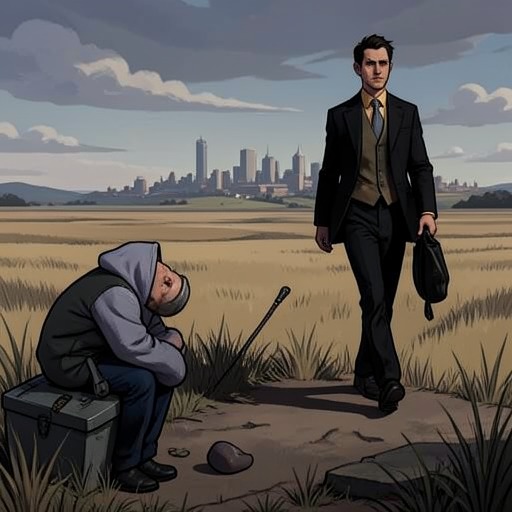
The child remains motionless on the rock, watching the vessel withdraw. The rising tide is beginning to bathe the rock, making his position physically precarious while the men continue away. As the hooker passes through the narrow neck of the crook and reaches the sea, its masthead briefly remains visible against the sky; then the vessel disappears. The sequence gives the child time to watch his last connection to the men vanish from sight. His stillness and silence do not lessen the force of the act. They make the separation appear complete before he can articulate what it means.
The narrative describes the child as astounded and dreamy, but also as confronting the dark reality of existence. He seems to have acquired experience too early, before childhood could make sense of it or protect him from it. The narrator speculates that such premature experience may create an obscure inward balance in which a child weighs God; the thought does not resolve the child’s response into a settled belief. Instead, it emphasizes the disproportion between his age and the knowledge forced upon him. At ten years old, he is left to encounter not only fear but the first judgment that human care has failed.
What Human Darkness Means
The account makes the abandonment concrete. The men were the only people the child knew, yet he could not say who they were; he had lived among them without feeling himself to belong to them. The narrative’s distinction between mere proximity and belonging clarifies how thoroughly he has been excluded. He has not lost a secure home or a recognized family within the scene as given: he has been left by people with whom his life had been spent, but without the consciousness of being one of them. Their departure makes that prior estrangement visible.
His material circumstances deepen the meaning of the title. He has no money, no shoes, scarcely any clothing, and not even a piece of bread. It is winter and night, and several leagues lie between him and the nearest human habitation. He does not know where he is. These details turn the broad statement about human darkness into a specific predicament: the child has been deprived of the means to travel safely, sustain himself, or even understand his location. The landscape is dangerous, but the immediate cause of his helplessness is the act of the people who brought him to the sea and left without him.
The Principle Established
The child feels that he has been put outside the pale of life and that man has failed him. Those perceptions closely join the title’s two terms. Night marks the external world he must now cross; human darkness names the betrayal that has placed him there. The image of a child between the rising night and the murmuring waves gives his abandonment a vast setting, but the scene’s moral focus remains sharply human. The sea and darkness surround him; the men have made him alone.
The phrase therefore establishes an interpretive standard rather than a claim that nature is harmless. The rock is exposed to the tide, the winter night lengthens the distance to shelter, and the child has no practical resources. Yet these hazards acquire their force in the wake of a human decision. By placing a silent departure at the center of the opening, the narrative asks the reader to measure danger not only by the scale of the natural world but also by the conduct of those who abandon a dependent child to it. In that contrast, human darkness is the more decisive one: it is not simply nightfall, but the withdrawal of responsibility.